How to Speak English Naturally: Mastering the Chunking Method
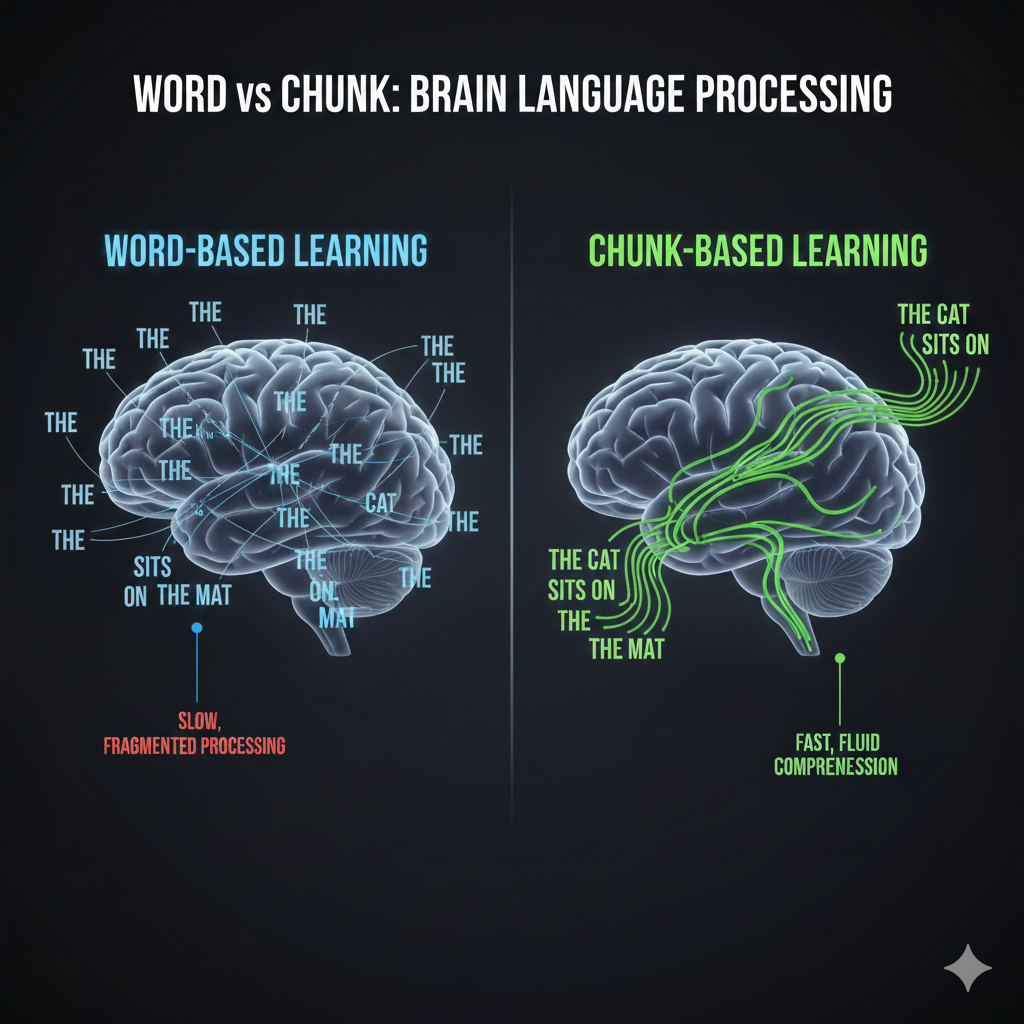
Thinking in Chunks: The Secret Behind Natural English Fluency
Most learners believe fluency means:
knowing more grammar
learning more vocabulary
But native speakers don’t build sentences word by word.
They speak in chunks.
This is the real bridge between
“I know English” → “I think in English.”
What Is Chunk Thinking?
A chunk is a ready-made block of language:
- “at the end of the day”
- “from my point of view”
- “it turns out that”
- “as far as I know”
Natives retrieve these as single units - like pressing one button instead of typing 10 letters.
This is why they sound fast and effortless.
Why Word-by-Word Thinking Fails
When you build sentences like LEGO blocks:
- choose word
- check grammar
- translate order
- speak
👉 You stay inside the translation loop.
Chunk thinking skips steps 1-3.
The B1 → B2 Turning Point
| Habit | B1 Speaker | B2 Speaker |
|---|---|---|
| Building | word → word | chunk → chunk |
| Pauses | inside sentences | between ideas |
| Speed | unstable | rhythmic |
| Effort | high | low |
This is why many learners get stuck at the B1 to B2 speaking gap.
5 Power Chunks Every Professional Needs
1) Opinion Chunks
- “from my perspective…”
- “I’m inclined to think…”
- “the way I see it…”
2) Structure Chunks
- “first of all…”
- “another key point is…”
- “to sum up…”
3) Clarification Chunks
- “what I mean is…”
- “in other words…”
- “let me put it this way…”
4) Disagreement Chunks
- “I see your point, however…”
- “I’m not fully convinced that…”
- “there might be another angle…”
5) Story Chunks
- “it all started when…”
- “what happened next was…”
- “that’s when I realized…”
How Chunks Stop Translation
Your brain no longer thinks:
native sentence → English sentence
It thinks:
idea → English chunk
This is the core of speaking without translating.
Englivo’s Chunk Engine
During AI Tutor and Live Practice, we track:
- Chunk density – how many blocks per minute
- Variety – not repeating the same 3 phrases
- Placement – beginning vs mid-sentence
- Natural pauses around chunks
These metrics decide your CEFR speaking level.
10-Minute Chunk Workout
Step 1 - Pick 5 chunks
Example:
- “from my perspective”
- “the main issue is”
- “as a result”
- “what surprised me was”
- “to be honest”
Step 2 - Speak 60 seconds
Topic: Your job or studies.
Step 3 - Count
Goal: 6–8 chunks/minute.
From B1 to B2 in Real Life
A B1 answer:
“I think the project is good but difficult, and we have problems.”
A chunked B2 answer:
“From my perspective, the main issue is timeline.
As a result, the team feels pressure.”
Same idea.
Different brain.
Learn More
-
Why chunks beat grammar:
Why Grammar Knowledge Doesn’t Create Fluency -
Professional routine:
Best English Practice for Professionals
FAQ
Do natives really use chunks?
Yes — over 70% of daily speech is formulaic blocks.
Can I memorize chunks?
Memorization helps, but usage builds reflex.
How many chunks to be fluent?
Around 300 active chunks for B2 interaction.
Ready to train with chunks instead of grammar?
👉 Start Live Practice
Want the full picture?
This article is part of our comprehensive guide to professional English fluency.
Start with the main roadmap →