Why Grammar Knowledge Doesn’t Create Fluency
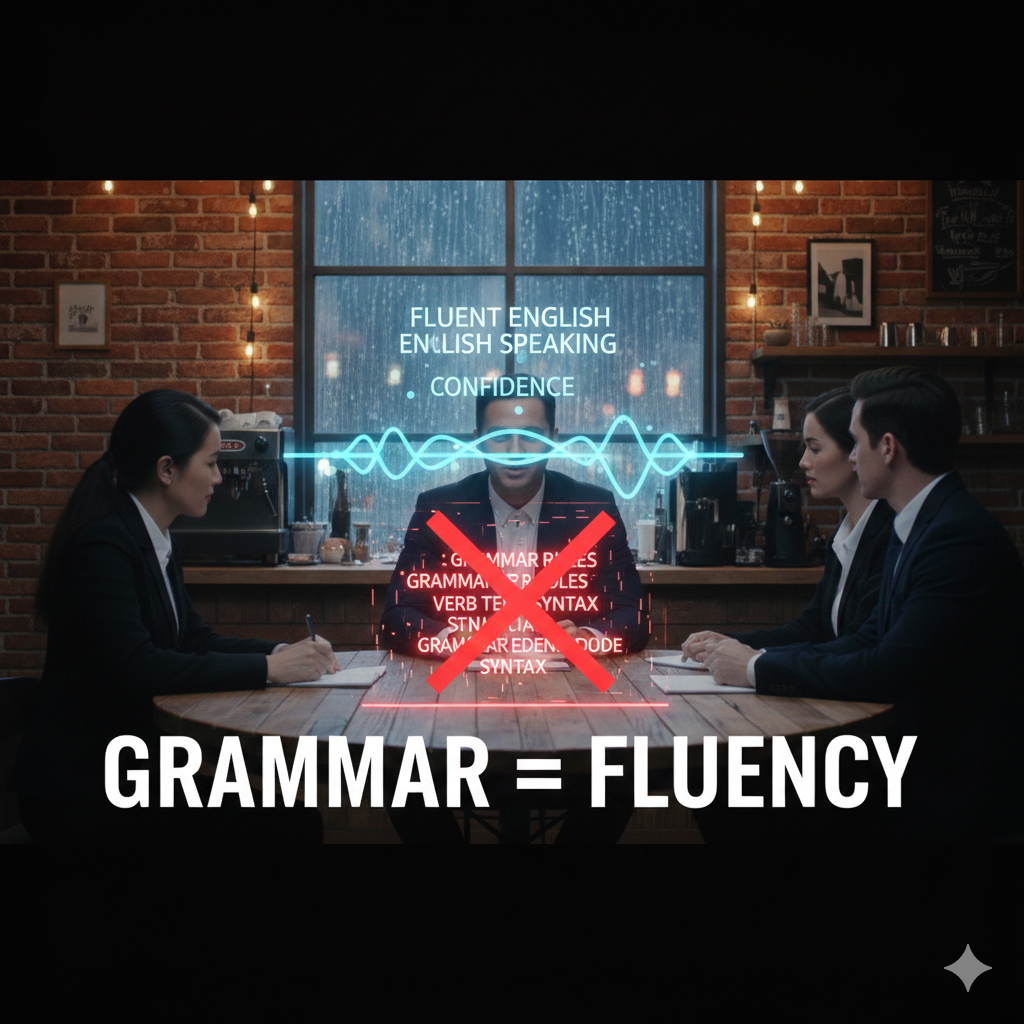
Why Grammar Knowledge Doesn’t Create Fluency
For years, you were told:
Learn the rules → speak better.
So you learned:
- tenses
- conditionals
- reported speech
- articles
- prepositions
Yet in real conversations, you still:
- hesitate
- translate
- lose confidence
- simplify your ideas
How is that possible?
Because grammar knowledge and fluency live in different parts of the brain.
The Two Brains of Language
Neuroscience divides learning into:
1) Declarative Memory - “Knowing ABOUT English”
This is where grammar lives:
- rules
- tables
- explanations
- exceptions
It’s perfect for:
- exams
- writing
- multiple-choice tests
But it’s slow.
2) Procedural Memory - “DOING English”
This is where fluency lives:
- speaking
- reacting
- storytelling
- negotiating
It works like:
- riding a bike
- playing piano
- driving a car
You don’t calculate - you perform.
School English vs Real English
| School English | Real English |
|---|---|
| Think → translate → speak | Idea → English directly |
| Focus on accuracy | Focus on impact |
| Stop to fix errors | Repair while moving |
| Sentences built word-by-word | Sentences built in chunks |
That’s why many top students still feel stuck in meetings.
👉 Read more:
Why You Can’t Stop Translating in Your Head
Why Grammar Fails Under Pressure
Imagine presenting to a client.
Your brain must handle:
- ideas
- structure
- audience
- emotion
There is no CPU left for grammar equations.
So the system switches to:
native language → translation loop
And fluency collapses.
The Illusion of “More Rules”
Learners often think:
“If I learn advanced grammar, I’ll sound fluent.”
But what really happens:
- more rules = more checking
- more checking = longer pauses
- longer pauses = lower fluency
Grammar grows → fluency shrinks.
What Actually Builds Fluency
1) Chunk Acquisition
Instead of:
I + think + that + maybe
You store:
- “from my perspective”
- “the main issue is”
- “what matters most is”
2) Automatic Repair
B2+ speakers don’t stop.
They say:
- “I mean…”
- “let me rephrase…”
- “in other words…”
3) Rhythm Over Perfection
Fluency =
stable rhythm + clear meaning + minor mistakes
Not perfect grammar.
👉 Related:
How Pauses Reveal Your True Fluency Level
How Englivo Trains the Right System
Our platform ignores “grammar score” as the main target.
We measure:
- Pause behavior
- Chunk usage
- Repair strategies
- Idea continuity
During Live Practice and AI Tutor, you train:
- procedural memory
- not rule memory.
See how your brain currently works →
Try AI Tutor Analysis
10-Minute Grammar Detox Plan
Minute 1-3: No-Rule Speaking
Talk about your day.
Zero grammar checking allowed.
Minute 4-6: Chunk Only
Use 5 frames:
- “from my experience…”
- “the challenge is…”
- “what surprised me was…”
Minute 7-10: Repair Practice
Never restart.
Use:
- “I mean…”
- “let me put it differently…”
Continue Learning
-
Why this leads to translation:
Stop Translating in Your Head -
How real fluency is built:
Thinking in Chunks: The Secret Behind Natural English -
CEFR impact:
B1 to B2 Speaking Gap
FAQ
Should I stop learning grammar?
No.
But grammar should support speaking - not control it.
Why can I write better than I speak?
Writing uses declarative memory.
Speaking uses procedural memory.
Can adults rewire this?
Absolutely - with daily speaking, not more rules.
Ready to train fluency instead of rules?
👉 Join Live Practice
Want the full picture?
This article is part of our comprehensive guide to professional English fluency.
Start with the main roadmap →